
Categories
- Support & Resources (31)
- Pipes & Fittings (35)
- Valves & Pumps (71)
- Instruments & Tools (23)
- Equipment, Chemicals & Consumables (25)
Metalsin‘s hybrid power SWRO desalination unit is engineered to bridge the gap between renewable energy sustainability and industrial-grade reliability. This system features a sophisticated complementary energy architecture that intelligently manages power inputs from wind turbines, solar photovoltaics (PV), and the local Grid or diesel generators. By leveraging wind and solar energy—which often peak at different times—the system maintains a stable power profile, significantly reducing the operational carbon footprint and dependence on expensive fuel.
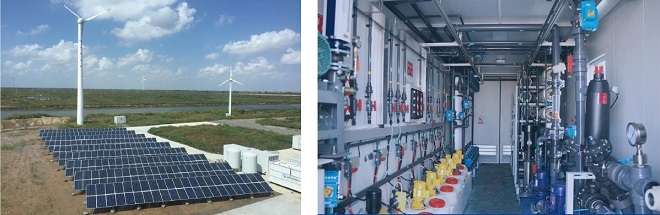
A coastal hybrid-powered (wind & solar) seawater RO desalination plant. A glimpse of the internal RO system in a mobile container.
This energy-agnostic unit utilizes advanced reverse osmosis (RO) technology optimized for variable power fluctuations, ensuring that water quality remains consistent even as energy sources switch. The entire system is built on a heavy-duty skid-mounted frame, allowing for easy integration into existing infrastructure, and can be fully containerized in standard 20ft or 40ft units. This modular design provides a turnkey, weather-protected solution that is “plug-and-play” for rapid deployment in remote coastal regions or offshore platforms.
To maximize the efficiency of the hybrid power supply, the unit integrates a high-efficiency Energy Recovery Device (ERD). The workflow begins with seawater being drawn through a multi-stage pre-treatment sequence, including chemical dosing and precision filtration to protect the RO membranes. The feed water is then pressurized by a high-pressure pump working in tandem with the ERD, which captures and recycles pressure energy from the concentrated brine stream. This integration allows the system to achieve its high-purity output while consuming significantly less electricity than conventional desalination units, making it the ideal partner for renewable energy sources.
| Specification | Parameter |
|---|---|
| Production Capacity | 10 ~ 1200 m³/day 10 ~ 1200 ton/day |
| Output Water Quality | TDS ≤ 500 ppm |
| Salt Rejection Rate | ≥ 99.2% |
| Energy Recovery Rate | 35% - 40% |
| Power Consumption | 1.0 ~ 3.8 kWh/m³ |
| Control System | Automated PLC Siemens/ABB |
| Operating Pressure | 4.0 - 6.5 MPa |
| Power Configuration | 220V, 380V, 440V 50Hz, 60Hz, 3-Phase |
| Materials | Duplex 2507, SS 316L FRP, uPVC, Al-Bronze |
| RO Membranes | Dow, Toray, GE, Hydranautics |
| Pressure Vessel | Firstline brand |
| Pumps | Grundfos, CNP, Diamond |
The heart of the hybrid system is a sophisticated Intelligent Power Management System (IPMS) that orchestrates the synergy between wind turbines, solar PV arrays, the utility Grid, and diesel generators. The configuration utilizes a DC-coupled or AC-coupled architecture where renewable energy is prioritized; high-efficiency solar panels capture diurnal energy while wind turbines harness nocturnal or seasonal breezes. An integrated industrial battery bank acts as a vital buffer, smoothing out the natural intermittency of renewables and ensuring that the high-pressure pumps receive a steady, regulated voltage regardless of environmental fluctuations.
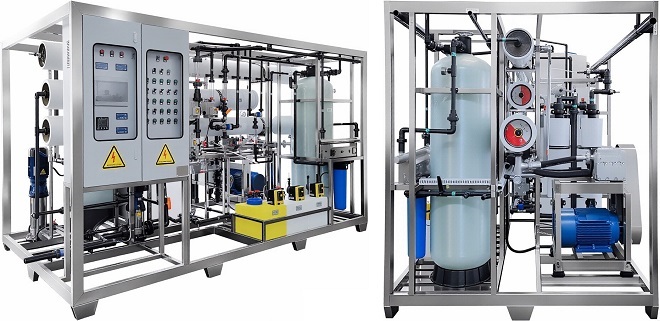
A typical skid-mounted SWRO unit that can be powered by a hybrid power system for uninterrupted operation.
When renewable output drops below the required threshold, the system intelligently toggles to Grid power or initiates the diesel generator to bridge the gap. This “seamless switching” capability is critical for SWRO applications, as reverse osmosis membranes are highly sensitive to pressure drops and frequent restarts, which can lead to premature fouling or mechanical fatigue. By using the grid or diesel as a secondary “fail-safe” layer rather than a primary source, the system significantly lowers the Levelized Cost of Water (LCOW) and ensures the desalination process remains in a steady state 24/7.
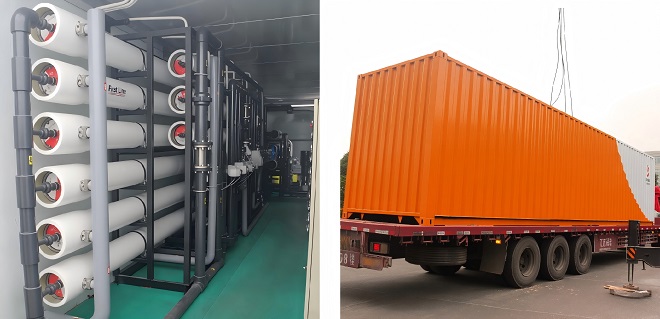
Containerized SWRO system with high mobility, easy trailer transport, and compatibility with hybrid energy systems for flexible deployment.
In practical application, this hybrid power system is the ultimate solution for remote island infrastructure and offshore energy hubs. By blending multi-source inputs, the system provides a UPS-like effect for the desalination unit, protecting the high-pressure components from the “water hammer” effects of power surges or outages. This reliability allows maritime and remote industrial operators to maintain a guaranteed daily freshwater yield of up to 200TPD or more, even in regions with unstable local grids or limited fuel logistics, effectively turning localized environmental assets into a consistent life-support utility.
Click to view more off-grid & energy-efficient seawater RO systems:
| Off-grid Solar (Photovoltaic) Powered Seawater RO Desalination |
| Energy Recovery Integrated SWRO with Ultra-low Power Consumption |
| Hybrid Power (Wind/Solar/Grid) SWRO Desalination Unit |