
Categories
- Support & Resources (31)
- Pipes & Fittings (35)
- Valves & Pumps (71)
- Instruments & Tools (23)
- Equipment, Chemicals & Consumables (25)
A corrosion-resistant SWRO (seawater reverse osmosis) system for offshore platforms is a specialized desalination solution designed to convert seawater into high-quality freshwater in harsh marine environments. For offshore platforms, water is more than a convenience—it is a mission-critical utility for cooling systems, boiler feed, and crew life support. The term “SWRO” refers to a process where seawater is pressurized and passed through semi-permeable membranes to remove dissolved salts and impurities, producing potable or industrial-grade water.
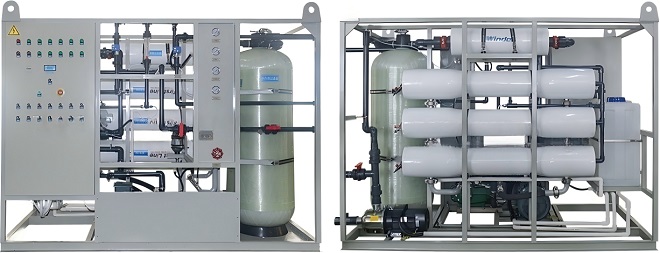
A skid-mounted corrosion-resistant seawater RO system for offshore drilling platforms, with a desalination capacity of 50 t/d.
“Corrosion-resistant” highlights a critical engineering requirement: offshore environments expose equipment to high salinity, humidity, oxygen, and temperature fluctuations—all of which accelerate material degradation. Metalsin achieves industry-leading corrosion resistance through a “material-first” engineering approach. Our systems utilize stainless steel 316L, super duplex 2507 stainless steel (with a PREN value > 41), marine-grade coatings, and FRP (fiberglass reinforced plastic) for all high-pressure piping, tanks and pump wet ends, providing immunity to pitting and stress corrosion cracking in high-salinity splash zones. These systems are specifically designed for:
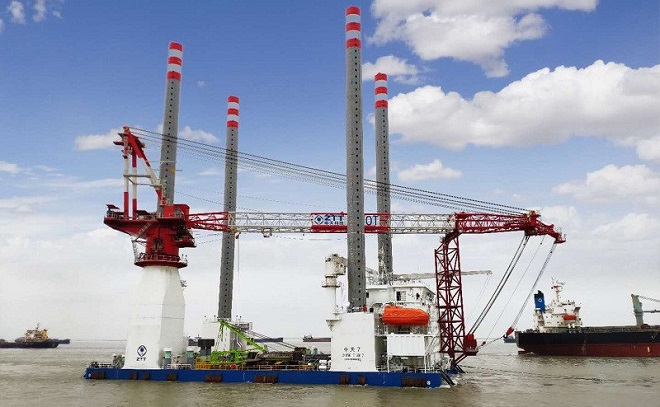
An offshore platform utilizing Metalsin‘s SWRO desalination systems. Uncompromising freshwater security for extreme maritime environments.
To meet the demanding requirements of offshore applications, modern corrosion-resistant SWRO systems are designed with a modular, skid-mounted or containerized structure that allows for easy transportation and installation in challenging marine environments. They incorporate high-efficiency RO membrane technology to ensure stable and consistent freshwater production, while integrated automation and remote monitoring systems enable reliable operation with minimal manual intervention. In addition, these systems are optimized for energy efficiency, often featuring optional energy recovery devices to reduce operational costs. Their compact footprint further makes them ideal for offshore platforms where space is limited, delivering a practical and high-performance desalination solution.
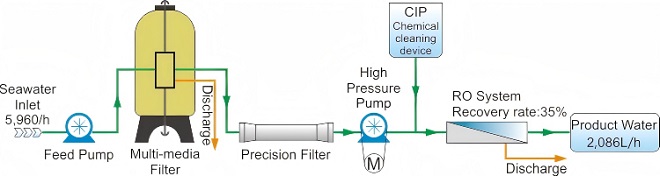
Typical process flow chart of the SWRO system for offshore platforms.
The corrosion-resistant seawater reverse osmosis (RO) desalination system for offshore platforms begins with seawater intake at approximately 5,960 L/h. A feed pump delivers the raw seawater into a multi-media filter, where larger suspended solids, sediments, and organic impurities are effectively removed to reduce the load on downstream equipment. The pretreated water then passes through a precision (cartridge) filter, which captures finer particles and residual contaminants. This two-stage filtration process ensures optimal water quality before entering the high-pressure section, protecting sensitive RO membranes from fouling and extending system lifespan.
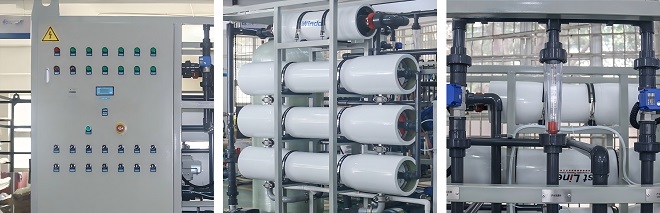
Components of the offshore SWRO system: control cabinet; RO systems; flow meters.
After fine filtration, the seawater is pressurized by a high-pressure pump to meet the operating requirements of the RO system. A built-in CIP (Clean-in-Place) chemical cleaning unit allows for efficient maintenance and membrane cleaning, ensuring long-term performance and reliability. The pressurized feedwater enters the RO membranes, where desalination occurs through advanced membrane separation, achieving a recovery rate of approximately 35%. The system produces around 2,086 L/h of high-quality fresh water suitable for offshore platform use, while the concentrated brine is safely discharged. This integrated process combines robust pre-treatment, high-pressure operation, and efficient membrane technology to deliver a reliable, energy-efficient, and corrosion-resistant seawater desalination solution for demanding offshore environments.
| Parameter | Specification |
|---|---|
| Feed Water Source | Seawater (TDS up to 35,000–36,000 mg/L) |
| System Capacity | Customized (2–300 m³/day or higher) |
| Recovery Rate | 30% – 45% |
| Operating Pressure | 55 – 80 bar (800 – 1,000 psi) |
| Membrane Type | Thin-film composite (TFC) membranes |
| Pre-treatment | Multi-media filter + cartridge filter |
| Materials | Duplex 2507, 316L, FRP, UPVC |
| Control System | Siemens PLC automation |
| Cleaning System | Integrated CIP unit |
| Installation Type | Skid-mounted |
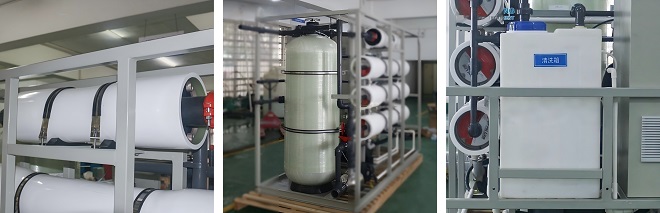
Main components: precision filter; multi-media filter; rinse tank.
This offshore seawater desalination system adopts advanced reverse osmosis technology with an optimized system design, delivering compact, lightweight, and highly adaptable performance for marine and offshore applications such as ships and drilling platforms. It efficiently removes salts, heavy metals, and microorganisms to produce high-quality drinking water compliant with international standards, featuring a desalination rate above 98.5% and stable operation.
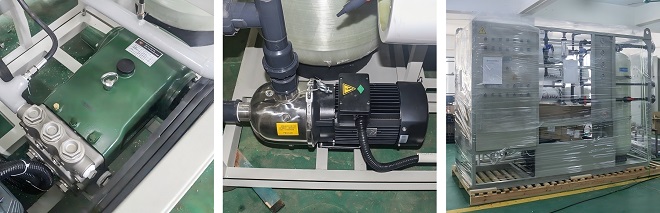
Main components series 03: high-pressure pump; feed pump; packaging of the SWRO equipment.
The system is easy to install, operate, and maintain, with automated protection functions, integrated cleaning (CIP) capabilities, and reliable components from leading brands. Designed for durability and energy efficiency, it offers flexible configurations, low maintenance costs, and a long service life of 15–20 years, making it a dependable solution for continuous freshwater supply wherever seawater and power are available.
| Compact Marine Seawater RO System for Commercial Fishing Vessels & Cargo Ships |
| Corrosion-resistant SWRO Desalination for Offshore Platforms |
| Compact Seawater RO System for Yachts | Yacht Water Maker |