Product Overview & Main Applications
The ductile iron repair clamp, commonly known as a leak repair clamp or split repair coupling, is a pipeline repair fitting designed for the rapid and reliable repair of leaks caused by holes, cracks, fractures, or joint failures in pipelines with push-on (socket & spigot) joints or flanged connections.
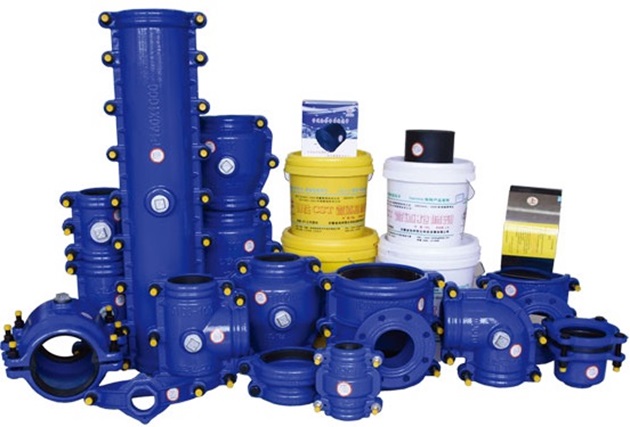
Diverse ductile iron repair clamps with blue epoxy coating RAL 5005.
*Click to view the specific ductile iron repair clamps for various piping conditions.
This clamp utilizes its unique structure to perform “wrap-around” repairs, allowing damaged pipes to be fixed with minimal or no interruption to the fluid service, achieving a reliable seal:
- Emergency Repair: Ideal for quick fixes in water supply, drainage, gas, petrochemical, and other fluid conveyance pipelines.
- Leak Repair: Specifically targets common pipe failures like pinholes, cracks, fractures, and leaks at various connection points (e.g., socket joints, flange joints, elbows, and tees).
- Applicable Media: Suitable for sealing pipes carrying water, medium/low-pressure gas, and oil.
Structural Features
SJZ Metalsin‘s ductile iron repair clamps feature a simple yet highly effective design. They are mainly composed of the following components:
- Clamp Body (Shell): The clamp body is manufactured from high-quality ductile iron, offering excellent mechanical strength, toughness, and corrosion resistance. It is typically composed of two semi-cylindrical shells (hence “half joints“), allowing the clamp to be easily installed around the exterior of the damaged pipe. The ductile iron material grades commonly comply with major international standards, including but not limited to: ASTM A536 Gr.65-45-12, EN 1563 EN-GJS-450-10 (5.3107), EN-JS-1040, and GB/T 1348 Grade QT450-10.
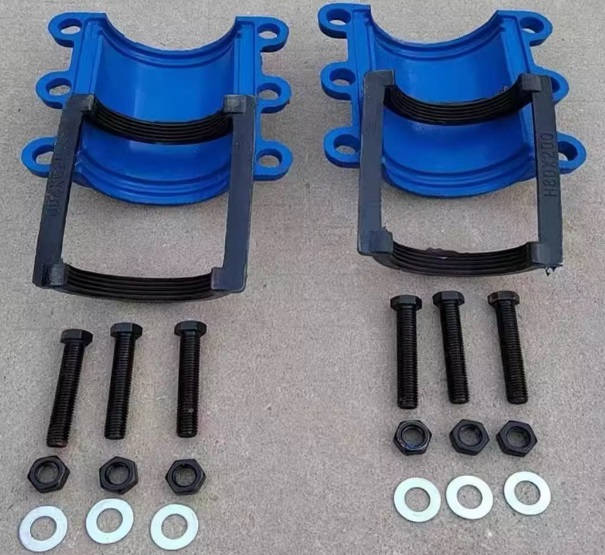
The typical components of a ductile iron repair clamp: two half bodies, EPDM gaskets, bolts, nuts, and washers
- Sealing Gasket: The gasket is the key sealing element of the repair clamp. It is usually made of high-quality elastomeric rubber materials such as EPDM, SBR, or NBR, arranged circumferentially along the inner surface of the clamp body. The gasket typically features lip-type profiles or grid-patterned surfaces, which enhance sealing performance. When the bolts are tightened, the gasket is compressed firmly against the outer surface of the pipe at the leakage point, forming a reliable and durable seal. The rubber sealing materials used by Metalsin fully meet potable water requirements and comply with relevant standards such as ASTM D2000, ISO 4633, EN 681-1, AWWA C111/A21.11, and GB/T 21873. Based on client requirements, we offer products with internationally recognized health and safety certifications, including NSF/ANSI 61, WRAS, GB/T 17219, KTW/UBA, and ACS.
- Bolts & Nuts: The bolts and nuts are used to connect the two half shells and apply sufficient radial force to compress the gasket. They are typically made from stainless steel (AISI 304 or 316), or carbon steel/ Cr-Mo alloy steel with galvanizing or PTFE coating for corrosion protection. Commonly supplied bolting grades include ASTM A193 B7 / ASTM A194 2H, Carbon Steel Grade 8.8, ASTM A193 B8/B8M, and ASTM A194 8/8M.
Working Principle
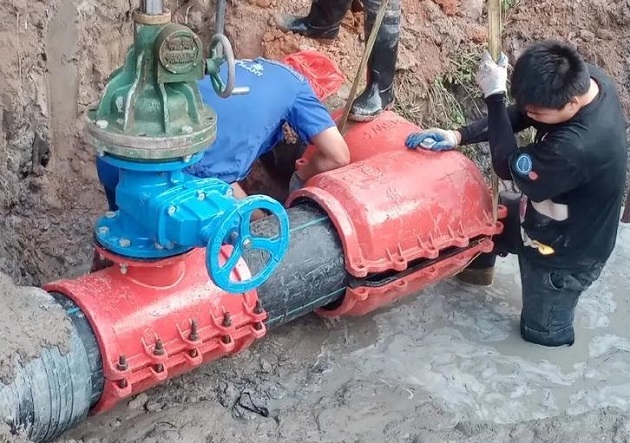
Hot-tapping repair clamp & 90° elbow joint repair clamp used for the maintenance of HDPE wastewater pipeline.
The ductile iron repair clamp operates on the principle of compression sealing. During installation, the two half shells (or multi-segment shells for larger diameters) are positioned and wrapped around the leaking section of the pipe. As the bolts and nuts are tightened, the clamp body contracts radially inward, exerting strong and uniform pressure on the rubber gasket. Under this radial compression, the elastomeric gasket conforms to surface irregularities of the pipe, filling gaps between the pipe and the clamp. Relying on the elasticity and resilience of the rubber, the clamp achieves a permanent or semi-permanent leak-tight seal.
Coating & Performance
Both the internal and external surfaces of Metalsin’s ductile iron repair clamps are coated with red or blue epoxy powder coating using electrostatic spraying technology. Before coating, the castings undergo thorough shot blasting to remove sand, rust, oil, moisture, and other impurities. The epoxy coating is then applied to a minimum total thickness of 150 μm.
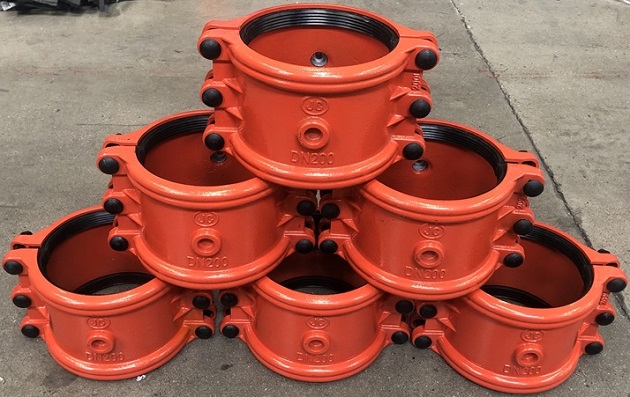
Ductile iron leak repair clamps in red epoxy coating.
Once cured, the epoxy coating is: (1) insoluble in water; (2) non-toxic and does not affect water quality; (3) resistant to corrosion, fouling, and environmental influences such as air and temperature changes. The coating materials comply with internationally recognized hygiene and safety standards and contain no substances harmful to potable water systems, ensuring no secondary pollution.
Hydrostatic Pressure Testing
All repair clamps are subjected to strict hydrostatic pressure tests:
- DN300 and smaller clamps must pass a test pressure of not less than 2.5 MPa.
- DN350 to DN600 clamps must pass a test pressure of not less than 1.6 MPa.
- DN700 and larger clamps must pass a test pressure of not less than 1.0 MPa.
The pressure must be maintained for at least 1 minute without leakage or structural damage to the shell. Official product inspection reports are provided by certified third-party authorities.
Advantages
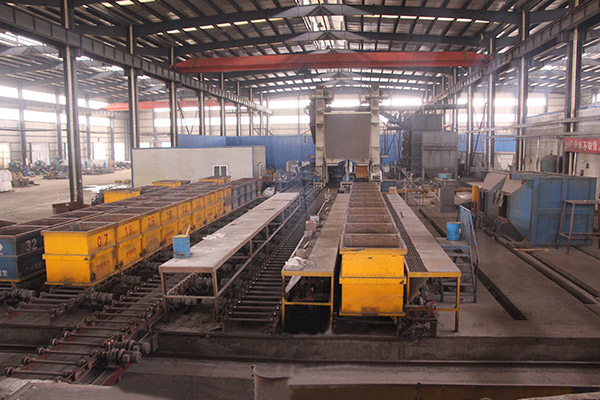
A glimpse of the casting workshop for the production of ductile iron repair clamps.
- Easy and Efficient Installation: No need for pipe cutting or complex welding. Simple tools allow for rapid installation, which is ideal for emergency repairs.
- High Adaptability: Capable of accommodating various pipe materials (e.g., cast iron, steel, PVC/PE pipes) and a certain range of pipe outer diameter tolerances.
- High Reliability: The ductile iron body guarantees structural integrity and strength, while the high-quality rubber gasket ensures long-term, reliable sealing performance.