
Categories
- Support & Resources (31)
- Pipes & Fittings (35)
- Valves & Pumps (71)
- Instruments & Tools (23)
- Equipment, Chemicals & Consumables (25)
Metalsin‘s Containerized Brackish Water RO Desalination System is a sophisticated, “plug-and-play” solution specifically engineered for high-salinity regions (wells, rivers, lakes) and areas suffering from seawater inversion. Designed using internationally advanced reverse osmosis technology, this system bridges the gap between unusable saline sources and a reliable, high-purity water supply.
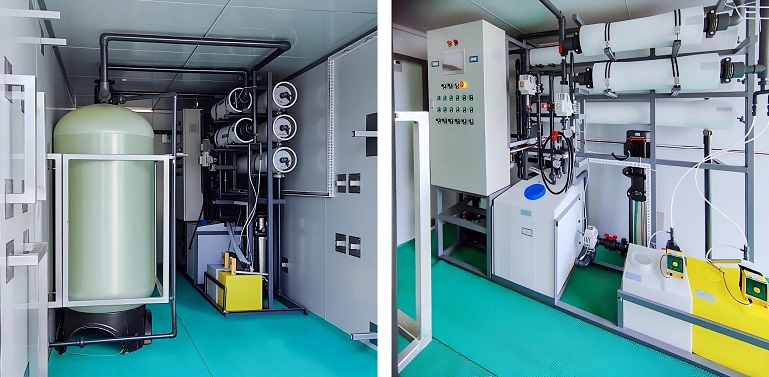
A typical containerized brackish water RO desalination system with the production capacity of 4 tons per hour (96 tons per day).
The entire equipment suite is integrated within a 20-feet or 40-feet standard shipping container, which offers distinct logistical advantages:
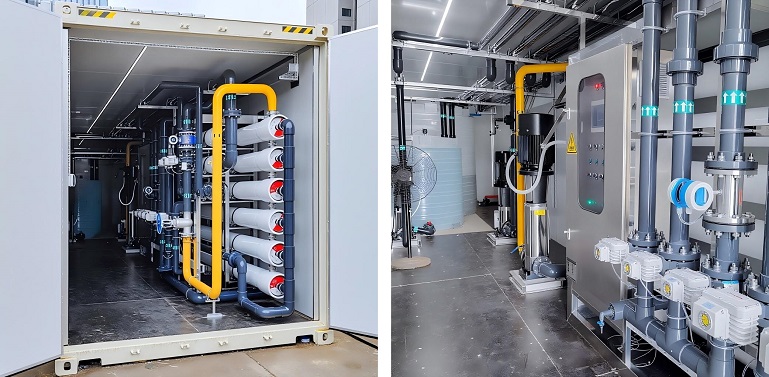
High-performance water purification for industrial and community needs: 40′-container housed, 30 ton per hour (720 ton per day) capacity.
This system acts as a molecular gatekeeper, effectively removing inorganic salts, heavy metal ions, organic matter, bacteria, and other harmful components from brackish water. The result is a consistent stream of high-quality freshwater that strictly adheres to international drinking water sanitation standards (GB5749-2022, WRAS, WHO, NSF, EN, JIS), ensuring safety and excellence in every drop.
Metalsin‘s containerized brackish-water RO desalination systems are engineered to meet stringent standards for safe potable water, supporting remote villages, island communities, and disaster relief efforts. By reducing TDS to optimal levels, these units transform saline-stressed regions into productive farmland through advanced hydroponics and precision irrigation, providing a critical buffer against seawater intrusion. This versatility extends to public infrastructure, offering centralized treatment for residential complexes, schools, and decentralized “second-tap” urban water networks.
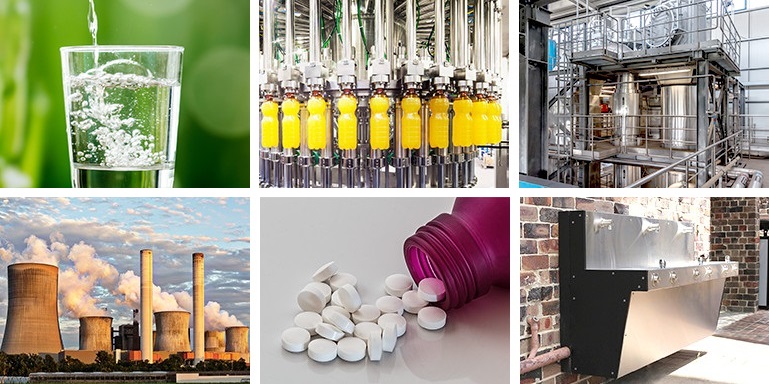
Versatile applications of the brackish water RO desalination system.
For high-precision sectors, the system delivers the high-purity process water required for pharmaceutical standards, power industry boiler feed, and food and beverage manufacturing. The mobile plug-and-play design is equally vital for mining and infrastructure development in remote areas, providing essential water for concrete mixing, dust suppression, and large-scale worker camps while eliminating the logistical burden of trucking freshwater. Furthermore, these systems facilitate industrial production and environmental remediation by treating brackish runoff to protect sensitive local ecosystems.
The treatment logic of Metalsin‘s brackish-water RO desalination unit begins with raw water entering the system via a feed pump. The water first passes through a robust pre-treatment stage consisting of a multi-media filter and an activated carbon filter to remove suspended solids, chlorine, and odors. A scale inhibitor dosing system and reduction dosing system then inject specialized chemicals to protect the membranes, followed by a precision filter and a softening bed (supported by a salt tank) to eliminate hardness and fine particulates.
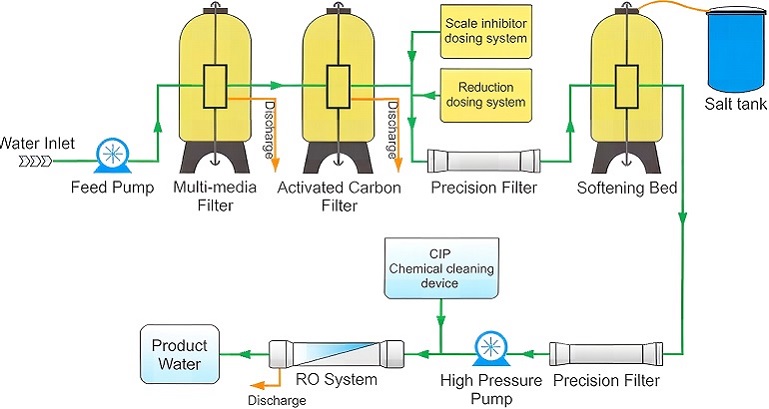
The workflow of brackish water desalination via the reverse osmosis process.
In the final stage, the pretreated water is pressurized by a high pressure pump and forced through the RO system (reverse osmosis membranes). This is where the primary desalination occurs, splitting the flow into high-purity product water and a concentrated brine discharge. To maintain long-term efficiency, an integrated CIP (Clean-In-Place) chemical cleaning device is included to periodically wash the membranes without disassembly, ensuring stable performance and extended membrane life.
| Feature | Specification |
|---|---|
| Production Capacity | 4~30 tons/hour 96~720 tons/day |
| Raw Water TDS | ≤ 4000 ppm ≤ 800 mg/L |
| Salt Rejection Rate | ≥ 98.5% |
| Output Water Quality | TDS ≤ 500mg/L TDS ≤ 100mg/L |
| Power Supply | AC 220V / 380V / 440V 50-60Hz, 3 Phase |
| Recovery Rate | 65% |
| Operation Pressure | 1~3.5 MPa |
| Operation Temperature | 5~50 °C |
| Rated Power | 7~30 kW |
| Ingress Protection | IP54 |
| Container Size | 20-feet GP 40-feet GP 40-feet HQ |
| RO Membranes | DOW or TORAY brand |
| Pumps | CNP or GRUNDFOS brand |
| Material Grade | SS 316L, FRP, Plastic |
| Electrical Components | Siemens, ABB, Schneider |
| Estimated Price | 38,500~92,700 USD |
| Handling Time | 20~40 days |
| Transit Time | 30 days |
| Global Shipment | By sea or by air |
| Payment Terms | T/T, L/C |
Find more details of RO desalination system for specialized industrial & EPC applications:
| Containerized Brackish Water RO Desalination System |
| Aquaculture UF+RO Desalination & Concentration System |
| Mobile Containerized SWRO for Sea Sand Washing |
Brackish water is water with a salinity level between fresh water and seawater, typically found in estuaries, inland salt lakes, or groundwater wells affected by seawater intrusion. In the context of our desalination systems, it generally refers to water with a Total Dissolved Solids (TDS) level up to 10,000 ppm.
The softening bed is a critical pre-treatment component that removes “hardness” ions—specifically calcium and magnesium—from the raw water. As shown in the process workflow, the softening bed works in conjunction with a salt tank to prevent mineral scale from forming on the sensitive Reverse Osmosis membranes, thereby ensuring high efficiency and system longevity.
Membrane CIP stands for “Clean-In-Place,” which is an integrated chemical cleaning device designed to wash the RO membranes periodically without requiring the disassembly of the equipment. This process is essential for maintaining long-term efficiency by removing organic fouling or mineral deposits that accumulate over time. By performing regular CIP cycles, operators can ensure stable production performance and significantly extend the service life of the membranes.